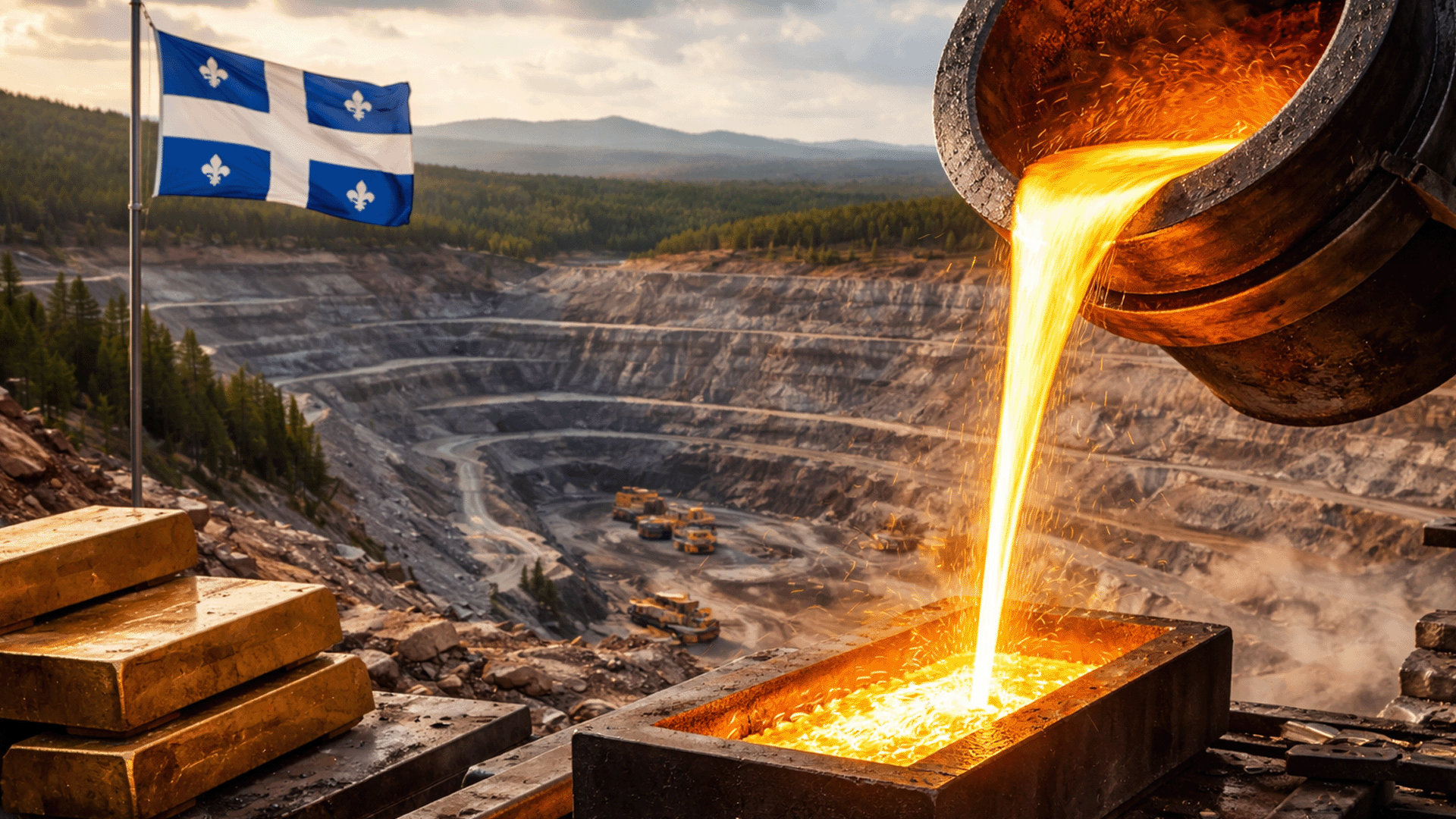
Built for a Gold Bull Marketone of the most productive gold regions globally. The project sits directly on the Cadillac Break, a structure that has produced more than 75 million ounces of gold over the last century. This is not an exploration theory — it is a proven gold address where mines get built, financed, and acquired.
At the foundation of the story is a defined NI 43-101 resource that already places Granada firmly on the institutional radar:
8.22 million tonnes grading 2.05 g/t gold, containing 543,000 ounces
The grade differential is important. The inferred material is more than twice the grade of the open-pit M&I resource, giving the project both scale and grade-growth leverage as drilling advances.This resource sits within a much larger mineralized system. Only ~2 km of a ~5.5 km strike length has been meaningfully drilled, meaning roughly 80% of the structure remains unexplored. Management is explicit about the upside potential, targeting a 2.5–3.0 million ounce gold system over time. In strong gold markets, this kind of open-ended district narrative is exactly what drives re-ratings.
Where Granada truly separates itself from typical juniors is in its grade reconciliation and bulk-sampling narrative. Two separate 500-tonne open-pit bulk samples returned grades of 4.33 g/t gold and 3.95 g/t gold, materially higher than the 2.05 g/t M&I resource grade. Historically, the mine produced gold at ~9.7 g/t, and management consistently emphasizes that mill grades have exceeded drill-derived grades.

it is a direct challenge to how the market may be valuing the deposit.Compounding that argument is the native gold component, which management estimates could represent up to ~50% of recoverable gold. Native gold systems are notorious for being under-represented in drill assays but over-performing once bulk material is processed. Granada is leaning into this dynamic through bulk sampling, gravity recovery, and metallurgical validation, rather than ignoring it.
Metallurgically, the story remains unusually clean for a junior gold project. Test work has indicated ~94–95% gold recoveries using gravity separation and conventional processing routes. High recoveries plus simple metallurgy is a combination that can dramatically compress the risk discount investors apply to early-stage developers.
The company is also not trapped in “study paralysis.” Granada holds permits that allow it to mine approximately 550 tonnes per day from an open pit, with the ability to ship ore to nearby mills. In parallel, management has outlined a “rolling start” strategy, where staged production and processing validation can precede full-scale development. This approach reduces time risk — one of the most underappreciated killers of junior valuations.

Granada is structurally built for that rotation.why investors are so invested.Built for a Gold Bull Marketone of the most productive gold regions globally. The project sits directly on the Cadillac Break, a structure that has produced more than 75 million ounces of gold over the last century. This is not an exploration theory — it is a proven gold address where mines get built, financed, and acquired.
At the foundation of the story is a defined NI 43-101 resource that already places Granada firmly on the institutional radar:
8.22 million tonnes grading 2.05 g/t gold, containing 543,000 ounces
The grade differential is important. The inferred material is more than twice the grade of the open-pit M&I resource, giving the project both scale and grade-growth leverage as drilling advances.This resource sits within a much larger mineralized system. Only ~2 km of a ~5.5 km strike length has been meaningfully drilled, meaning roughly 80% of the structure remains unexplored. Management is explicit about the upside potential, targeting a 2.5–3.0 million ounce gold system over time. In strong gold markets, this kind of open-ended district narrative is exactly what drives re-ratings.
Where Granada truly separates itself from typical juniors is in its grade reconciliation and bulk-sampling narrative. Two separate 500-tonne open-pit bulk samples returned grades of 4.33 g/t gold and 3.95 g/t gold, materially higher than the 2.05 g/t M&I resource grade. Historically, the mine produced gold at ~9.7 g/t, and management consistently emphasizes that mill grades have exceeded drill-derived grades.

it is a direct challenge to how the market may be valuing the deposit.Compounding that argument is the native gold component, which management estimates could represent up to ~50% of recoverable gold. Native gold systems are notorious for being under-represented in drill assays but over-performing once bulk material is processed. Granada is leaning into this dynamic through bulk sampling, gravity recovery, and metallurgical validation, rather than ignoring it.
Metallurgically, the story remains unusually clean for a junior gold project. Test work has indicated ~94–95% gold recoveries using gravity separation and conventional processing routes. High recoveries plus simple metallurgy is a combination that can dramatically compress the risk discount investors apply to early-stage developers.
The company is also not trapped in “study paralysis.” Granada holds permits that allow it to mine approximately 550 tonnes per day from an open pit, with the ability to ship ore to nearby mills. In parallel, management has outlined a “rolling start” strategy, where staged production and processing validation can precede full-scale development. This approach reduces time risk — one of the most underappreciated killers of junior valuations.

Granada is structurally built for that rotation.why investors are so invested.Qualified Person:
The technical information in this news release was reviewed and approved by Matthew Halliday, P.Geo., Director of Granada Gold Mine Inc., and member of the Ordre des Géologues du Québec, who is a Qualified Person in accordance with National Instrument 43-101.


execution-driven, not headline-driven. The company is led by a CEO with a deep background in metallurgy, gravity recovery, flotation, and refining — precisely the skill set required to unlock value in a native-gold system.This matters because Granada’s strategy is not “drill endlessly and hope.” It is about proving ounces are real, recoverable, and potentially under-modeled. Bulk sampling, reconciliation, and recoveries are the core value levers — and management’s technical background aligns perfectly with that objective.
The broader team brings strength across resource geology, public-company finance, governance, and capital markets, creating a balanced platform capable of moving from exploration into development without a total reset. That continuity is important to investors who want to avoid “new team, new vision” risk every cycle.
What keeps investors invested is catalyst density. Granada does not rely on a single moment to work. It offers multiple paths to success:As of the most recent presentation, Granada carried:
That structure creates classic junior gold asymmetry: limited downside relative to asset scale, but significant upside if even one or two catalysts land.
This is why Granada attracts long-term holders rather than only short-term traders. The story compounds. Each successful step doesn’t end the narrative — it unlocks the next chapter.Granada can move to the upside if any of the following are consistently proven:When those conditions exist in a rising gold environment, valuation math changes fast.Granada Gold Mine is not a concept. It is a past-producing, district-scale gold system with a defined resource, high-grade upside, simple metallurgy, and a management team focused on execution rather than theory.With ~1 million ounces already defined, a 5.5 km mineralized structure, bulk samples grading ~4 g/t, recoveries near 95%, and a micro-cap valuation, Granada offers exactly what aggressive gold investors look for at the early stages of a bull cycle:
Leverage, validation, and asymmetric upside.execution-driven, not headline-driven. The company is led by a CEO with a deep background in metallurgy, gravity recovery, flotation, and refining — precisely the skill set required to unlock value in a native-gold system.This matters because Granada’s strategy is not “drill endlessly and hope.” It is about proving ounces are real, recoverable, and potentially under-modeled. Bulk sampling, reconciliation, and recoveries are the core value levers — and management’s technical background aligns perfectly with that objective.
The broader team brings strength across resource geology, public-company finance, governance, and capital markets, creating a balanced platform capable of moving from exploration into development without a total reset. That continuity is important to investors who want to avoid “new team, new vision” risk every cycle.
What keeps investors invested is catalyst density. Granada does not rely on a single moment to work. It offers multiple paths to success:As of the most recent presentation, Granada carried:
That structure creates classic junior gold asymmetry: limited downside relative to asset scale, but significant upside if even one or two catalysts land.
This is why Granada attracts long-term holders rather than only short-term traders. The story compounds. Each successful step doesn’t end the narrative — it unlocks the next chapter.Granada can move to the upside if any of the following are consistently proven:When those conditions exist in a rising gold environment, valuation math changes fast.Granada Gold Mine is not a concept. It is a past-producing, district-scale gold system with a defined resource, high-grade upside, simple metallurgy, and a management team focused on execution rather than theory.With ~1 million ounces already defined, a 5.5 km mineralized structure, bulk samples grading ~4 g/t, recoveries near 95%, and a micro-cap valuation, Granada offers exactly what aggressive gold investors look for at the early stages of a bull cycle:
Leverage, validation, and asymmetric upside.Qualified Person:
The technical information in this news release was reviewed and approved by Matthew Halliday, P.Geo., Director of Granada Gold Mine Inc., and member of the Ordre des Géologues du Québec, who is a Qualified Person in accordance with National Instrument 43-101.