The Largest Defence Modernization Cycle in DecadesNATO defence spending is accelerating, as it works toward its 2035 readiness commitments after decades of under-investment, taking part in a global rearmament cycle now measured at $3.6 trillion (Global X ETFs, Defense Tech Enters 2026 with Strengthening Fundamentals). That alliance-wide acceleration flows directly into Canada's response: in March 2026, the federal government launched its first Defence Industrial Strategy, committing more than $500 billion (Government of Canada, Security, Sovereignty, Prosperity, 2024) between 2025 and 2035, the largest defence budget since the Second World War.
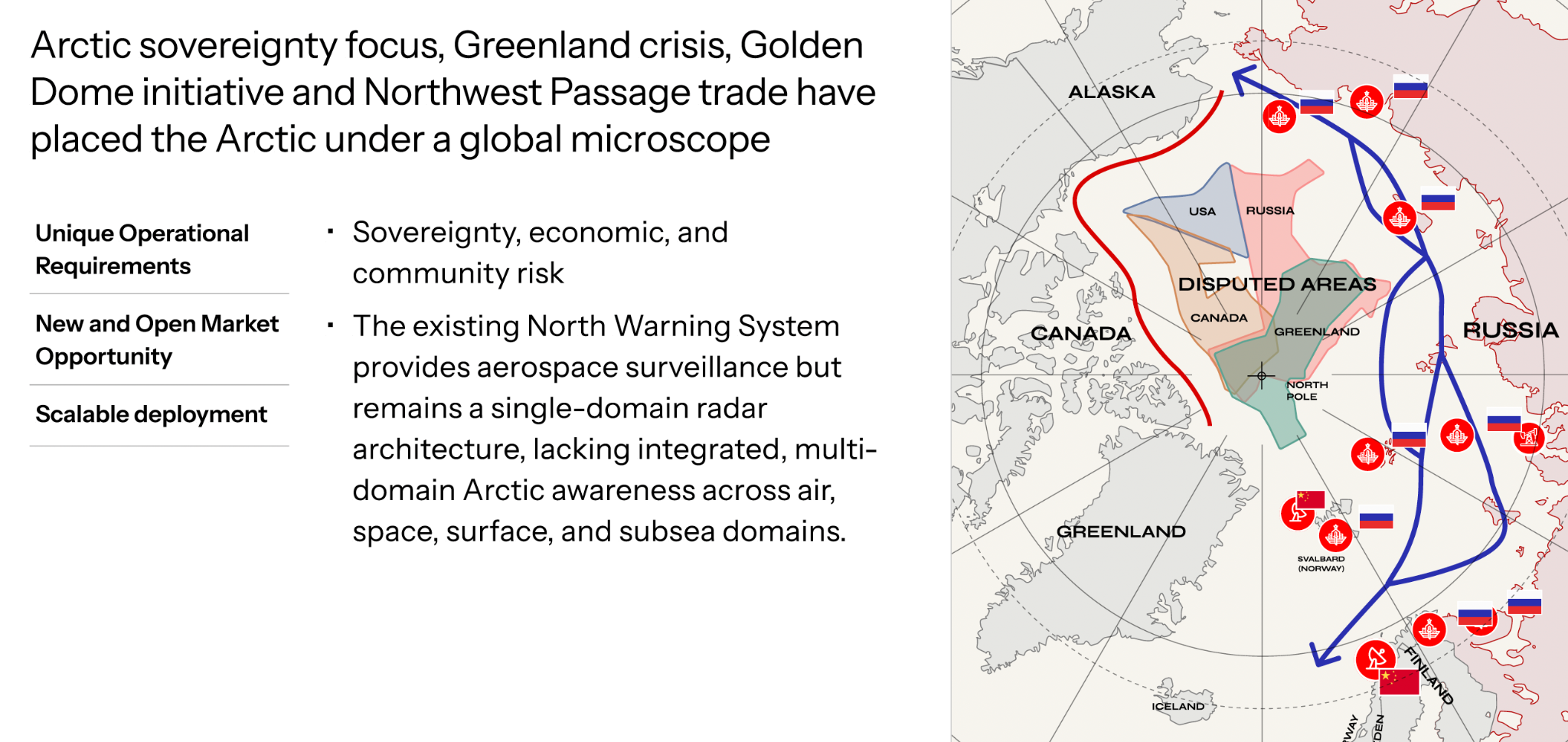
Within that commitment is $80 billion+ allocated to enhancing Canada’s overall military capabilities and meeting NATO’s 5% of GDP spending benchmark. Also, $32 billion is being allocated specifically to Arctic sovereignty & NORAD modernization (Our North, Strong and Free, 2024). The Greenland crisis, the Golden Dome initiative, and Northwest Passage trade have placed the Canadian North under a global microscope. At the same time, the existing North Warning System remains a single-domain radar architecture with no integrated awareness across air, space, surface, and subsea. Underlying all of this, AI and autonomous warfare are becoming the norm as the battlefield grows increasingly software-defined, and procurement systems across NATO begin to prioritize exactly this kind of innovation.

Canada's strategy is not just an increase in funding; it is a deliberate act of sovereignty protection. In the government's own words, the Defence Industrial Strategy is built around homegrown strengths and sovereign capabilities, and the new procurement rules reorder who gets to sell to Ottawa. Duplicative approvals are being removed to accelerate procurement. Domestic spending is targeted to rise by 70% as the country shifts away from overreliance on the United States (Canada's Defence Industrial Strategy, 2026).
Government projections call for the Canadian defence sector to grow by 300%, exports to rise 50%, and domestic R&D to grow by 85% (Security, Sovereignty and Prosperity: Canada's Defence Industrial Strategy, 2026). The strategy also names ten key sovereign capabilities Canada intends to own rather than import, and near the top of that list sit uncrewed and autonomous systems, sensors, and digital systems spanning artificial intelligence and integrated command, control, and communications. Prime Minister Mark Carney has described this as the largest generational investment in Canada's defence spending, one designed to bring equipment to the Canadian Armed Forces faster while reinforcing strategic ties with domestic industry (Prime Minister Carney launches Canada's first Defence Industrial Strategy to strengthen security, create prosperity, and reinforce strategic autonomy, 2026).

According to PitchBook data, new venture funding for defence tech SMEs climbed steadily from 2019 to reach record levels in 2025, part of a year in which the sector raised $48 billion and produced ten new defence tech unicorns (Forbes, 2025). Anduril raised $6.26 billion in total (Sacra, 2026), including a $2.5 billion Series G in June 2025, reaching a $30.5 billion valuation at roughly 30.5x EV/revenue on the back of autonomous systems contracts such as the Pentagon's Replicator program, with revenue of roughly $1 billion in 2024 — up about 120% year-over-year (TechCrunch, 2025).
Palantir, which turns complex data into real-time operational decisions for defence applications, was the single best-performing S&P 500 stock in the first half of 2025 (Motley Fool, 2025) and trades at roughly 59x trailing EV/revenue as of July 16, 2026 (StockAnalysis, 2026). The unmanned aerial vehicle market alone is projected to grow at a 16.4% compound annual rate from 2026 to 2034 (Fortune Business Insights, 2026).
Meanwhile, the pool of publicly traded companies with meaningful Canadian relevance remains relatively small, including Draganfly, Ondas, Red Cat, Volatus Aerospace, and Kraken Robotics (Yahoo Finance, 2026). The opportunity is clear across both private and public markets: capital is flowing into the sector at an unprecedented pace, and valuations reflect genuine scarcity rather than speculation. Yet Canadian public investors have virtually no domestic opportunity to invest in the very technological paradigm their own government is actively funding. Demand has already been proven. Supply has not. That disconnect is where the opportunity lies.
The Largest Defence Modernization Cycle in DecadesNATO defence spending is accelerating, as it works toward its 2035 readiness commitments after decades of under-investment, taking part in a global rearmament cycle now measured at $3.6 trillion (Global X ETFs, Defense Tech Enters 2026 with Strengthening Fundamentals). That alliance-wide acceleration flows directly into Canada's response: in March 2026, the federal government launched its first Defence Industrial Strategy, committing more than $500 billion (Government of Canada, Security, Sovereignty, Prosperity, 2024) between 2025 and 2035, the largest defence budget since the Second World War.
Within that commitment is $80 billion+ allocated to enhancing Canada’s overall military capabilities and meeting NATO’s 5% of GDP spending benchmark. Also, $32 billion is being allocated specifically to Arctic sovereignty & NORAD modernization (Our North, Strong and Free, 2024). The Greenland crisis, the Golden Dome initiative, and Northwest Passage trade have placed the Canadian North under a global microscope. At the same time, the existing North Warning System remains a single-domain radar architecture with no integrated awareness across air, space, surface, and subsea. Underlying all of this, AI and autonomous warfare are becoming the norm as the battlefield grows increasingly software-defined, and procurement systems across NATO begin to prioritize exactly this kind of innovation.

Canada's strategy is not just an increase in funding; it is a deliberate act of sovereignty protection. In the government's own words, the Defence Industrial Strategy is built around homegrown strengths and sovereign capabilities, and the new procurement rules reorder who gets to sell to Ottawa. Duplicative approvals are being removed to accelerate procurement. Domestic spending is targeted to rise by 70% as the country shifts away from overreliance on the United States (Canada's Defence Industrial Strategy, 2026).
Government projections call for the Canadian defence sector to grow by 300%, exports to rise 50%, and domestic R&D to grow by 85% (Security, Sovereignty and Prosperity: Canada's Defence Industrial Strategy, 2026). The strategy also names ten key sovereign capabilities Canada intends to own rather than import, and near the top of that list sit uncrewed and autonomous systems, sensors, and digital systems spanning artificial intelligence and integrated command, control, and communications. Prime Minister Mark Carney has described this as the largest generational investment in Canada's defence spending, one designed to bring equipment to the Canadian Armed Forces faster while reinforcing strategic ties with domestic industry (Prime Minister Carney launches Canada's first Defence Industrial Strategy to strengthen security, create prosperity, and reinforce strategic autonomy, 2026).

According to PitchBook data, new venture funding for defence tech SMEs climbed steadily from 2019 to reach record levels in 2025, part of a year in which the sector raised $48 billion and produced ten new defence tech unicorns (Forbes, 2025). Anduril raised $6.26 billion in total (Sacra, 2026), including a $2.5 billion Series G in June 2025, reaching a $30.5 billion valuation at roughly 30.5x EV/revenue on the back of autonomous systems contracts such as the Pentagon's Replicator program, with revenue of roughly $1 billion in 2024 — up about 120% year-over-year (TechCrunch, 2025).
Palantir, which turns complex data into real-time operational decisions for defence applications, was the single best-performing S&P 500 stock in the first half of 2025 (Motley Fool, 2025) and trades at roughly 59x trailing EV/revenue as of July 16, 2026 (StockAnalysis, 2026). The unmanned aerial vehicle market alone is projected to grow at a 16.4% compound annual rate from 2026 to 2034 (Fortune Business Insights, 2026).
Meanwhile, the pool of publicly traded companies with meaningful Canadian relevance remains relatively small, including Draganfly, Ondas, Red Cat, Volatus Aerospace, and Kraken Robotics (Yahoo Finance, 2026). The opportunity is clear across both private and public markets: capital is flowing into the sector at an unprecedented pace, and valuations reflect genuine scarcity rather than speculation. Yet Canadian public investors have virtually no domestic opportunity to invest in the very technological paradigm their own government is actively funding. Demand has already been proven. Supply has not. That disconnect is where the opportunity lies.
This report is a deliberately bullish, one-sided framing assembled from the company's own public materials. A complete investment decision requires the bear case, the risks, the financials, and independent verification — none of which are presented here.
Forward-looking items (the "modern defence prime" ambition, Polar Nexus, M&A plans) are goals and works-in-progress, not realized results or guaranteed contracts.
Early-stage defence-technology ventures carry substantial execution, regulatory, dilution, and liquidity risk.
I am not a licensed financial advisor, and nothing here is personalized investment advice. Consult a qualified, licensed professional and do your own due diligence before making any investment decision.
*Sources:
Global X ETFs — Defense Tech Enters 2026, Gov. of Canada — Our North, Strong and Free (2024), Gov. of Canada — Defence Industrial Strategy (2026), PMO — Carney launches Defence Industrial Strategy (2026), Forbes — Military Startup Unicorns (2025), Sacra — Anduril (2026), TechCrunch — Anduril $2.5B Raise (2025), Motley Fool — Palantir Top S&P 500 Stock (2025), StockAnalysis — PLTR Statistics (2026), Fortune Business Insights — UAV Market (2026), Yahoo Finance — Red Cat (RCAT) Stats (2026), NATO — Hague Summit Declaration (2025), NAADSN — Arctic Over-the-Horizon Radar Primer (2025), Newsfile — Juno / Trail Blazer RTO (2026), Embedded video (YouTube)
Disclaimer
Departures Capital Inc. ("We" or "Us") are not securities dealers or brokers, investment advisers or financial advisers, and you should not rely on the information herein as investment advice. Juno Industries Inc. will make aggregate payments of CAD $20,000 to Departures Capital Inc. to provide marketing services for a term of 6 months.
This article is informational only and is solely for use by prospective investors in determining whether to seek additional information. This does not constitute an offer to sell or a solicitation of an offer to buy any securities. Examples that we provide of share price increases pertaining to a particular issuer from one referenced date to another represent an arbitrarily chosen time period and are no indication whatsoever of future stock prices for that issuer and are of no predictive value.
Our stock profiles are intended to highlight certain companies for your further investigation; they are not stock recommendations or constitute an offer or sale of the referenced securities. The securities issued by the companies we profile should be considered high risk; if you do invest despite these warnings, you may lose your entire investment.
Please do your own research before investing, including reading the company's SEDAR+ filings, press releases, and risk disclosures. It is our policy that information contained in this profile was provided by the company, extracted from SEDAR+ filings, the company's website, and other publicly available sources. We believe the sources and information are accurate and reliable but we cannot guarantee it.
Forward Statements
This article contains forward-looking statements about Juno Industries Inc., which are identified by terms such as "anticipate," "expect," "project," "intend," "plan," "believe," "may," "will," and similar expressions. These statements reflect current views regarding the company's performance, business goals, product development timelines, government procurement outcomes, defence spending trends, and the broader defence technology industry.
The statements are based on current business and market expectations, including assumptions regarding Canada's Defence Industrial Strategy, NATO spending commitments, government procurement processes, and the commercial development of Juno's SPECTRE system, Polar Nexus platform, and SPECTRE OS. However, they involve various risks and uncertainties, including potential delays, financial difficulties, and operational challenges. Additional risks include possible regulatory approval delays, market disruptions, personnel issues, and competitive pressures. Additional risks specific to Juno Industries include, without limitation: failure to obtain procurement contracts or regulatory approvals; changes in government defence spending priorities or policy; the early-stage nature of certain products and technologies; the competitive nature of the defence technology sector; risks associated with completing the proposed reverse takeover and TSX Venture Exchange listing; and general economic and geopolitical conditions.
Given these risks and uncertainties, actual results may differ significantly from what is described in the forward-looking statements. Readers should not place undue reliance on these statements, which are only valid as of the article's publication date and we undertake no obligation to update.

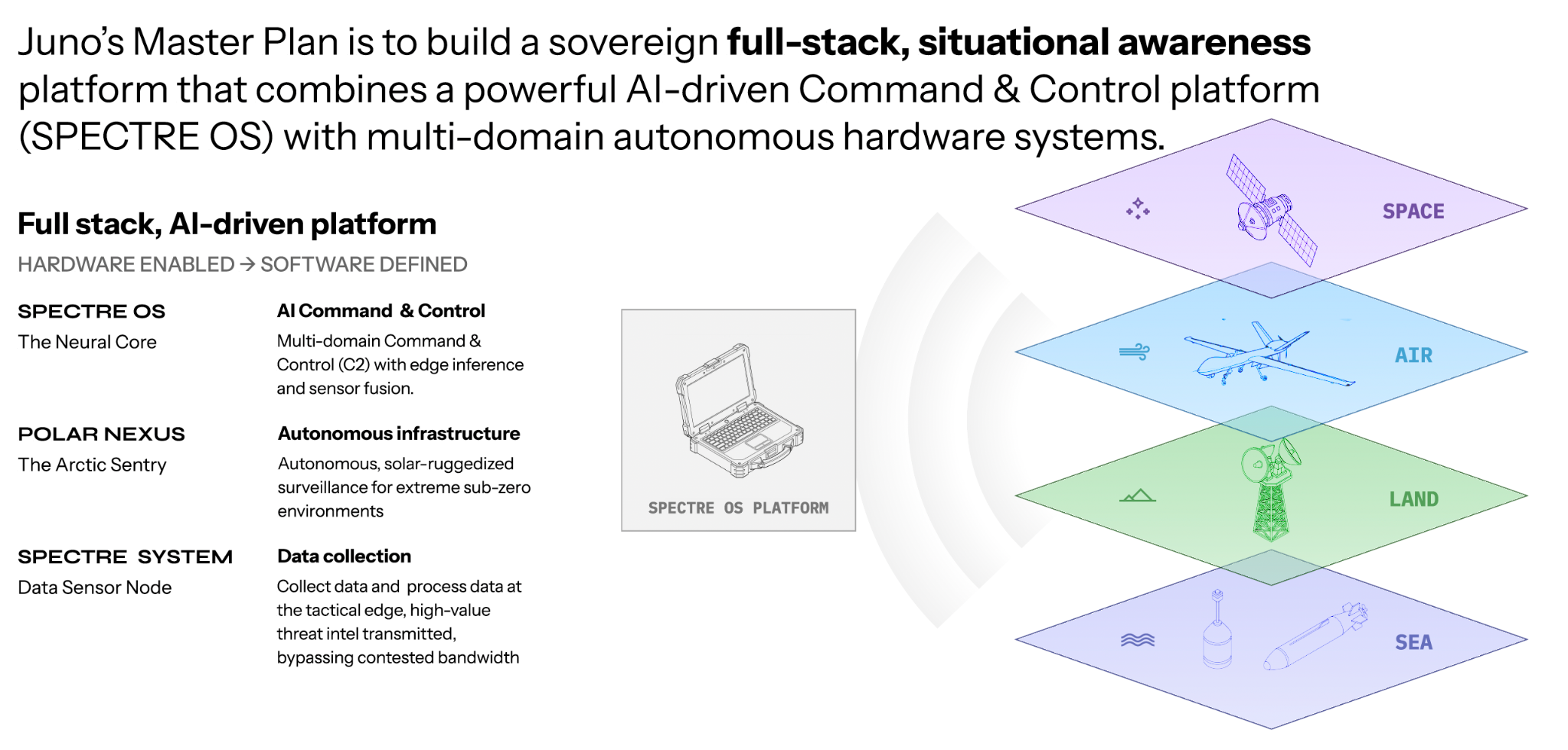
One Connected Model, Built by People Who Understand How Defence Is BoughtOne Network, Not Just Differentiated Products. Juno’s products are best understood by examining their core capabilities: autonomous systems collect data via sensors, and the data feeds into the AI command-and-control platform, turning raw multi-domain data into actionable intelligence and decision advantage. With this intelligence, Juno can build new targeted products and systems, which is essential for fast innovation timelines.The SPECTRE system is a full-stack situational awareness platform that leverages edge compute nodes via a specialized mobile sensor network, processing data at the tactical edge and transmitting high-value threat intelligence. It has been tested by the Canadian military and integrates directly with existing Canadian Armed Forces C2ISR platforms, demonstrating Juno's needs-based, fast-innovation approach.
At the autonomous infrastructure layer, Polar Nexus is a hardened autonomous tower system for encrypted communication and advanced sensing in the harshest operating environments with upgrades forthcoming for Arctic and defence deployments, delivered in partnership with Critical Infrastructure Technologies Inc.
Juno is currently building SPECTRE OS, which is the data integration layer that all of the hardware systems feed into. It's a full-stack, software-defined command-and-control platform: it takes in data from Juno’s sensors, fusing it into one live operating system, allowing operators to gather real-time intelligence. The strategic objective is to own the command-and-control data layer itself. In modern defence software, the greatest value lies in the sense–process–decide–act loop, where raw signals become actionable decisions.
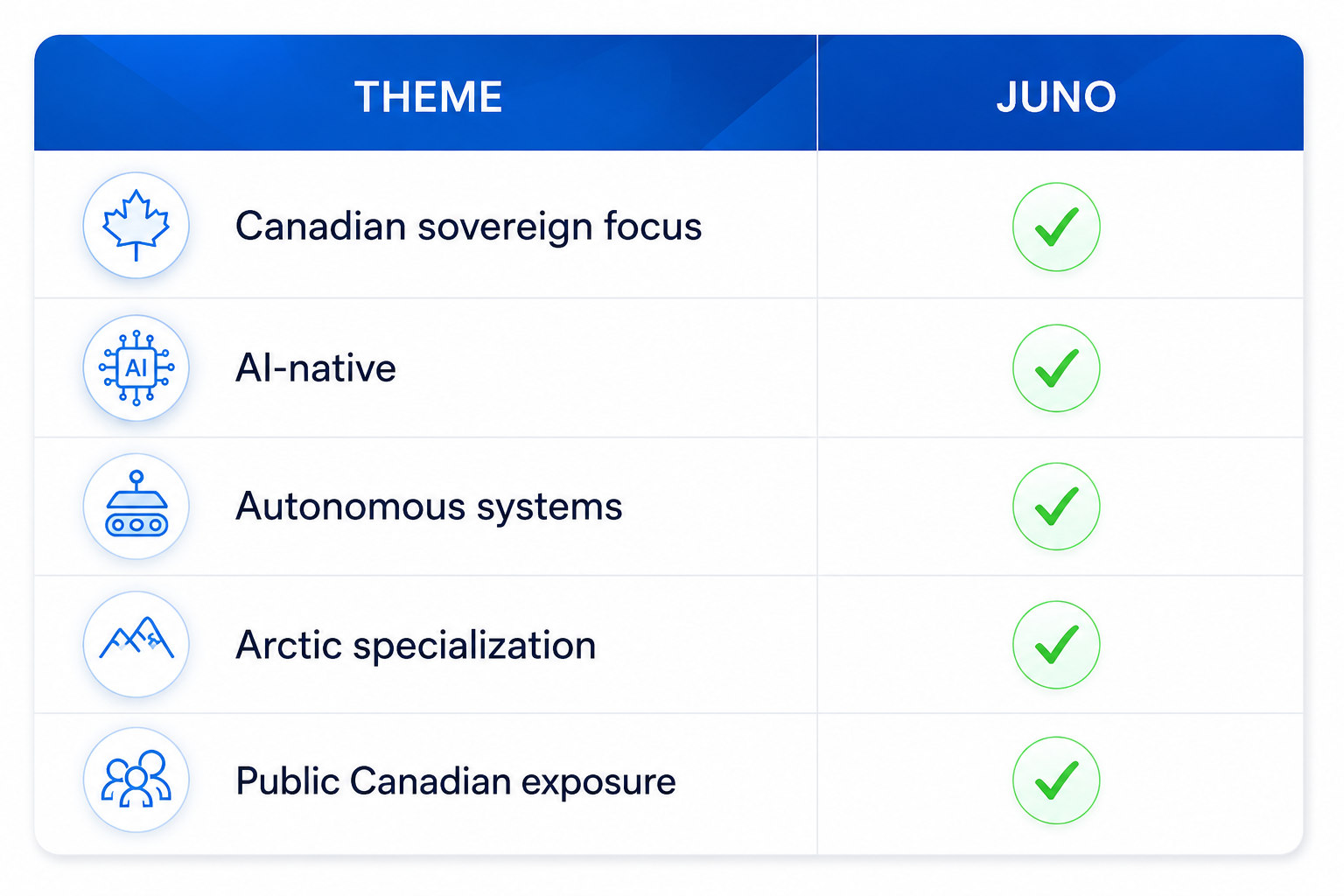
That connected model is also what separates Juno from the alternatives an investor might compare it against. Legacy primes have a limited Canadian sovereign focus, are at best only partially AI-native, carry mixed autonomous capability, and offer little genuine Arctic specialization. U.S. defence tech leaders are AI-native and strong in autonomy, but they are not Canadian sovereign suppliers; they have limited Arctic focus, and they offer Canadian public investors no domestic exposure.
In a procurement environment that has just rewritten its rules to favour sovereign suppliers and has named autonomous systems, sensors and AI command-and-control among its ten protected capabilities, this combination creates a durable structural advantage that is challenging to replicate.
Juno's edge starts with its people. Executive Chairman and Co-founder Harjit S. Sajjan is Canada's former Minister of National Defence and brings firsthand knowledge of how defense priorities get set and how procurement decisions actually get made. CEO and Co-founder Hunter Scharfe is a deep-tech entrepreneur and financier who recently served as a Senior Advisor at BTQ Technologies. Head of Product Strategy Tania Belisle-Leclerc served as Director of Policy to both the Minister of National Defence and the Minister of Foreign Affairs. Lieutenant General (Ret'd) Michael Hood, former Commander of the Royal Canadian Air Force, advises on aerospace and defence strategy.
That political and operational depth is matched by equally distinguished technical expertise. The advisory team brings together leaders in artificial intelligence, robotics, autonomous systems, and advanced computing with experience developing technologies that have helped define Canada’s innovation ecosystem. The result is a rare combination of strategic insight, technical excellence, and real-world execution capability spanning the full lifecycle of modern defence innovation.
On March 25, 2026, Juno and Trail Blazer Capital Corp. announced a definitive agreement to complete a reverse takeover and TSX Venture Exchange listing, alongside a $12 million CAD subscription receipt financing priced at $0.80 per receipt. Combined with the $3.5 million raised in Q4 2025, the transaction will result in a pro forma capital structure of approximately 41.1 million shares outstanding (Newsfile, 2026).
Juno’s vision is to become one of Canada’s leading defence technology companies, developing advanced sensor systems and autonomous platforms that strengthen the capabilities of Canada and its NATO allies. The path forward will be defined by execution, customer adoption, procurement awards, and the continued expansion of defence investment. As Canada undertakes a generational effort to rebuild its domestic defence industrial base, Juno is positioning itself to become a sovereign defence technology leader at the center of that transformation.One Connected Model, Built by People Who Understand How Defence Is BoughtOne Network, Not Just Differentiated Products. Juno’s products are best understood by examining their core capabilities: autonomous systems collect data via sensors, and the data feeds into the AI command-and-control platform, turning raw multi-domain data into actionable intelligence and decision advantage. With this intelligence, Juno can build new targeted products and systems, which is essential for fast innovation timelines.The SPECTRE system is a full-stack situational awareness platform that leverages edge compute nodes via a specialized mobile sensor network, processing data at the tactical edge and transmitting high-value threat intelligence. It has been tested by the Canadian military and integrates directly with existing Canadian Armed Forces C2ISR platforms, demonstrating Juno's needs-based, fast-innovation approach.
At the autonomous infrastructure layer, Polar Nexus is a hardened autonomous tower system for encrypted communication and advanced sensing in the harshest operating environments with upgrades forthcoming for Arctic and defence deployments, delivered in partnership with Critical Infrastructure Technologies Inc.
Juno is currently building SPECTRE OS, which is the data integration layer that all of the hardware systems feed into. It's a full-stack, software-defined command-and-control platform: it takes in data from Juno’s sensors, fusing it into one live operating system, allowing operators to gather real-time intelligence. The strategic objective is to own the command-and-control data layer itself. In modern defence software, the greatest value lies in the sense–process–decide–act loop, where raw signals become actionable decisions.
That connected model is also what separates Juno from the alternatives an investor might compare it against. Legacy primes have a limited Canadian sovereign focus, are at best only partially AI-native, carry mixed autonomous capability, and offer little genuine Arctic specialization. U.S. defence tech leaders are AI-native and strong in autonomy, but they are not Canadian sovereign suppliers; they have limited Arctic focus, and they offer Canadian public investors no domestic exposure.
In a procurement environment that has just rewritten its rules to favour sovereign suppliers and has named autonomous systems, sensors and AI command-and-control among its ten protected capabilities, this combination creates a durable structural advantage that is challenging to replicate.
Juno's edge starts with its people. Executive Chairman and Co-founder Harjit S. Sajjan is Canada's former Minister of National Defence and brings firsthand knowledge of how defense priorities get set and how procurement decisions actually get made. CEO and Co-founder Hunter Scharfe is a deep-tech entrepreneur and financier who recently served as a Senior Advisor at BTQ Technologies. Head of Product Strategy Tania Belisle-Leclerc served as Director of Policy to both the Minister of National Defence and the Minister of Foreign Affairs. Lieutenant General (Ret'd) Michael Hood, former Commander of the Royal Canadian Air Force, advises on aerospace and defence strategy.
That political and operational depth is matched by equally distinguished technical expertise. The advisory team brings together leaders in artificial intelligence, robotics, autonomous systems, and advanced computing with experience developing technologies that have helped define Canada’s innovation ecosystem. The result is a rare combination of strategic insight, technical excellence, and real-world execution capability spanning the full lifecycle of modern defence innovation.
On March 25, 2026, Juno and Trail Blazer Capital Corp. announced a definitive agreement to complete a reverse takeover and TSX Venture Exchange listing, alongside a $12 million CAD subscription receipt financing priced at $0.80 per receipt. Combined with the $3.5 million raised in Q4 2025, the transaction will result in a pro forma capital structure of approximately 41.1 million shares outstanding (Newsfile, 2026).
Juno’s vision is to become one of Canada’s leading defence technology companies, developing advanced sensor systems and autonomous platforms that strengthen the capabilities of Canada and its NATO allies. The path forward will be defined by execution, customer adoption, procurement awards, and the continued expansion of defence investment. As Canada undertakes a generational effort to rebuild its domestic defence industrial base, Juno is positioning itself to become a sovereign defence technology leader at the center of that transformation.This report is a deliberately bullish, one-sided framing assembled from the company's own public materials. A complete investment decision requires the bear case, the risks, the financials, and independent verification — none of which are presented here.
Forward-looking items (the "modern defence prime" ambition, Polar Nexus, M&A plans) are goals and works-in-progress, not realized results or guaranteed contracts.
Early-stage defence-technology ventures carry substantial execution, regulatory, dilution, and liquidity risk.
I am not a licensed financial advisor, and nothing here is personalized investment advice. Consult a qualified, licensed professional and do your own due diligence before making any investment decision.
*Sources:
Global X ETFs — Defense Tech Enters 2026, Gov. of Canada — Our North, Strong and Free (2024), Gov. of Canada — Defence Industrial Strategy (2026), PMO — Carney launches Defence Industrial Strategy (2026), Forbes — Military Startup Unicorns (2025), Sacra — Anduril (2026), TechCrunch — Anduril $2.5B Raise (2025), Motley Fool — Palantir Top S&P 500 Stock (2025), StockAnalysis — PLTR Statistics (2026), Fortune Business Insights — UAV Market (2026), Yahoo Finance — Red Cat (RCAT) Stats (2026), NATO — Hague Summit Declaration (2025), NAADSN — Arctic Over-the-Horizon Radar Primer (2025), Newsfile — Juno / Trail Blazer RTO (2026), Embedded video (YouTube)
Disclaimer
Departures Capital Inc. ("We" or "Us") are not securities dealers or brokers, investment advisers or financial advisers, and you should not rely on the information herein as investment advice. Juno Industries Inc. will make aggregate payments of CAD $20,000 to Departures Capital Inc. to provide marketing services for a term of 6 months.
This article is informational only and is solely for use by prospective investors in determining whether to seek additional information. This does not constitute an offer to sell or a solicitation of an offer to buy any securities. Examples that we provide of share price increases pertaining to a particular issuer from one referenced date to another represent an arbitrarily chosen time period and are no indication whatsoever of future stock prices for that issuer and are of no predictive value.
Our stock profiles are intended to highlight certain companies for your further investigation; they are not stock recommendations or constitute an offer or sale of the referenced securities. The securities issued by the companies we profile should be considered high risk; if you do invest despite these warnings, you may lose your entire investment.
Please do your own research before investing, including reading the company's SEDAR+ filings, press releases, and risk disclosures. It is our policy that information contained in this profile was provided by the company, extracted from SEDAR+ filings, the company's website, and other publicly available sources. We believe the sources and information are accurate and reliable but we cannot guarantee it.
Forward Statements
This article contains forward-looking statements about Juno Industries Inc., which are identified by terms such as "anticipate," "expect," "project," "intend," "plan," "believe," "may," "will," and similar expressions. These statements reflect current views regarding the company's performance, business goals, product development timelines, government procurement outcomes, defence spending trends, and the broader defence technology industry.
The statements are based on current business and market expectations, including assumptions regarding Canada's Defence Industrial Strategy, NATO spending commitments, government procurement processes, and the commercial development of Juno's SPECTRE system, Polar Nexus platform, and SPECTRE OS. However, they involve various risks and uncertainties, including potential delays, financial difficulties, and operational challenges. Additional risks include possible regulatory approval delays, market disruptions, personnel issues, and competitive pressures. Additional risks specific to Juno Industries include, without limitation: failure to obtain procurement contracts or regulatory approvals; changes in government defence spending priorities or policy; the early-stage nature of certain products and technologies; the competitive nature of the defence technology sector; risks associated with completing the proposed reverse takeover and TSX Venture Exchange listing; and general economic and geopolitical conditions.
Given these risks and uncertainties, actual results may differ significantly from what is described in the forward-looking statements. Readers should not place undue reliance on these statements, which are only valid as of the article's publication date and we undertake no obligation to update.